Introduction
“Individual differences in g pervade all aspects of life, from simple everyday activities to the most complex intellectual achievements” (Jensen, 1998).
Intelligence is the largest single predictor of success across many domains of life. For instance, the meta-analytic correlation of IQ and school achievement is r = .54 (Roth et al., 2015). Likewise for occupational performance, intelligence is the strongest single predictor with, for instance, validity coefficients averaging r = .51 for complex jobs (Schmidt & Hunter, 1998). In both domains, however, there are strong incentives, for instance, in the case of work, income and promotion, and structural constraints: for instance, compulsory attendance and systematic provision of learning opportunities in the case of education (Tucker-Drob & Bates, 2016). Both education and employment are also socially reinforced as core components of socio-economic status (Galobardes et al., 2007). The present brief report explores whether general intelligence extends to predicting knowledge in a specialized domain which lacks such incentives, using the example of wine knowledge, and controlling for employment-linked incentives.
The present study explored whether the predictive power of g extends to depth of knowledge in specialized domains, and when these lack such systematic extrinsic incentives. Here, we chose wine knowledge as an initial example to examine. According to Jensen (1998), high g strongly predicts general knowledge primarily because knowledge and vocabulary formation depend heavily on complex, g-loaded cognitive processes—such as inferring meanings from context (education of relations/correlates), generalization, discrimination of subtle shades of meaning, and conceptual understanding—rather than on rote memorization, formal schooling, sheer exposure volume, or cultural factors alone. Jensen described this broad pattern as the “g nexus”: the pervasive tendency for general intelligence to correlate with performance, learning, and knowledge acquisition across highly diverse domains. Importantly, the “g nexus” implies not merely that intelligence predicts success in formal educational settings, but that g contributes more generally to the acquisition, organization, and integration of all complex information. Wine knowledge, characterized by complex taxonomies of grape varieties, regional classifications, and chemical processes, provides a high-complexity domain to test Jensen’s “default hypothesis” – that g is the primary driver of individual differences in learning.
Many measures not designed as ability tests correlate around as well with general ability as do more formal ability scales. For instance Gignac and Stevens (2024) found that financial literacy was strongly linked to IQ, and Lin and Bates (2022) found economic knowledge was strongly predicted by IQ and, paradoxically, was not predicted by formal education in economics. Likewise, Hambrick et al. (2007) reported that intelligence predicted individual differences in current events knowledge, even after accounting for personality and interests, suggesting that higher-ability individuals acquire broader knowledge from everyday informational environments. More generally, research on expertise and knowledge acquisition has repeatedly shown that cognitive ability contributes to the efficient acquisition and organization of structured domain knowledge across a wide range of interests and activities (Ackerman, 1996; Lubinski, 2004).
One can argue, however, that knowledge of finance and the economy are strongly incentivized by their links to SES and income, that such relations might not extend to knowledge lacking such utility and not formally taught. We searched, therefore, for a domain of knowledge which (1) does not feature in most school curricula, and (2) for which we could control for employment-linked incentives. We settled on wine knowledge.
It is important to note that assessment of vocabulary and general knowledge has been a staple of cognitive testing at least since Binet and Simon (1905) and Wechsler (1958). General knowledge in this sense is aligned with what E. D. Hirsch Jr. termed “Cultural Literacy” – the shared information forming the foundation of our public discourse, essential to comprehending news, and understanding our fellow man, norms, and leaders (Hirsch et al., 2002). Here, we sought to move beyond this “common knowledge” to examine the autonomous development of domain-specific depth. We hypothesized that high-ability individuals not only master the broad array of “core” facts, but also manifest this in what we term “deep shafts” of knowledge—driven by internal cognitive demand rather than broadly relevant external incentives. In the present study, we focus on a battery of questions assessing deep knowledge concentrated within a single, highly specific domain. By controlling for professional and personal value, we test whether the predictive power of g extends to the depth and density of specialized information, rather than just the breadth of socially reinforced facts.
While much research on intelligence has focused on academic achievement and problem solving (Carroll, 2005; Schneider & McGrew, 2018), intelligence also predicts the acquisition of knowledge more broadly. Theoretical models interpret these findings by distinguishing between fluid and crystallized intelligence (Cattell, 1987; Horn & Cattell, 1967; McGrew, 2009). Jensen (1998) emphasized that while crystallized intelligence is influenced by culture, the rate and depth of its acquisition are fundamentally constrained by g. Intelligence is believed to facilitate the acquisition of knowledge through the efficient organization and application of complex information (Schmidt, 2002). This view is captured well by “Investment Theory” (Ackerman, 1996), which posits that g – what Ackerman calls “intelligence-as-process” – is invested into specific domains to build “intelligence-as-knowledge”. Individuals with higher cognitive ability are more likely to acquire and apply complex bodies of information efficiently, supporting expertise development in both academic and non-academic domains. Jensen (1998) also emphasized biological correlates of g, detailing how g correlates with biological indicators, from brain volume (Gignac & Bates, 2017; McDaniel, 2005), and neural conduction velocity (Vernon & Mori, 1992), to reaction time (Jensen, 2006; Ritchie et al., 2013). He argued that these correlations point to differences in “biological efficiency” of the nervous system as the cause (a “force of nature”), not the consequence of correlates such as high educational attainment.
Both investment theory and biological bases of intelligence in learning mechanisms predict that g should extend to any domain requiring the discrimination of stimuli and the storage of complex information. Such associations would be weaker than those found with educational or occupational outcomes, emphasizing that while g reflects broad neurological efficiency, its effects are most visible in domains where learning and problem-solving are systematic. In light of Jensen’s work, wine knowledge represents an “interesting midpoint”. It is not a biological trait, yet it demands active knowledge acquisition and classification—faculties Jensen identified as being saturated with g. Thus, we propose that wine expertise will reflect, in part, underlying general intelligence.
Wine Knowledge and the WSET Level 2 Qualification
To test this prediction of the role of general intelligence in wine knowledge, we operationalized knowledge through performance on a standardized segment of the Wine and Spirit Education Trust (WSET) Level 2 Award in Wines (Wine and Spirit Education Trust, 2023). The WSET 2 is an internationally recognized qualification for both wine trade professionals and dedicated consumers (Wine and Spirit Education Trust, 2023). Unlike academic assessments, it offers limited extrinsic incentive for non-professionals, making it a suitable metric for evaluating IQ under low-incentive conditions. The WSET 2 curriculum (Wine and Spirit Education Trust, 2023) emphasizes foundational wine theory, organized around grape varieties and wine styles. Success requires memorizing and integrating a wide body of structured information—demands reflecting crystallized intelligence (Horn & Cattell, 1967). Despite being introductory in scope, WSET 2 places nontrivial cognitive demands on learners. The course text presents factual knowledge with limited visual scaffolding, requiring self-directed study strategies such as active recall, which correlate with cognitive ability (Dunlosky et al., 2013). The closed-book, time-limited format further requires rapid information retrieval and decision-making, processes aligned with fluid reasoning and working memory (Conway et al., 2003). Importantly, WSET certifications are pursued by both professionals and non-professionals, allowing us to distinguish intrinsic interest from occupational advancement. This aligns with models viewing intelligence as a domain-general facilitator of learning (Ackerman & Hambrick, 2020; Schmidt, 2002).
Hypotheses
We hypothesized that individuals with higher intelligence would demonstrate greater wine knowledge. This association was expected to hold when controlling for whether individuals are professionally engaged with wine, thus isolating the effect of g from direct occupational exposure, which we predicted also to be a positive predictor. Finally, we further expected the associations between IQ and wine knowledge to remain after controlling for wine drinking behavior, which we likewise predicted to be a positive predictor, suggesting that the acquisition of specialized knowledge is driven by g rather than merely by environmental advantage.
Method
Participants
A total of N = 525 participants (M = 43.15 years, SD = 13.47) were recruited from Prolific.com. Of these, 257 were female and 268 were male. Ethnic make-up was Asian 35; Black 18; Other 14; Southeast Asian 1; White 457. Of these participants, 458 reported never having worked in the wine industry (Group 0: none), 9 had entry-level experience such as vineyard, import, or wholesale work (Group 1: entry level), 42 had experience working as a waiter or waitress in wine service (Group 2: retail experience), and 11 had certified wine retail experience (Group 3). 152 reported that they mostly drink beer, 131 identified as teetotal (Group: No alcohol), and 238 reported that they mostly drink wine. Some participants did not respond to these items.
Measures
Wine knowledge was assessed using 68 multiple-choice items adapted from publicly available learning materials designed to prepare candidates for the WSET Level 2 examination (Wine and Spirit Education Trust, 2023). Each item was presented in a multiple-choice format including four answer options, with only one correct response. The items were organized according to six learning outcomes related to wine knowledge and scores were computed by summing the number of correct responses across all items. Example items are shown in Table 1.
Cognitive ability was assessed with three subscales of the International Cognitive Ability Resource (ICAR; Condon & Revelle, 2014), a large, public, battery of cognitive ability measures. The scales chosen were the 9-item Letter and Number Series scale, in which participants view sequences of digits or letters and choose the likely next item in the sequence from six choices, the 11-item Matrix Reasoning test which presented 3 × 3 arrays of geometric shapes with one shape missing requiring participants to select the missing shape from six options, and the 16-item Verbal Reasoning scale which assesses logic, vocabulary, and general knowledge. Scores for each subscale were calculated according to ICAR scoring procedures and combined into a composite IQ score. The composite IQ score was subsequently standardized within the present sample to a mean of 100 and a standard deviation of 15.
Occupational exposure was measured via a self-report scale of professional wine industry background. Participants selected their highest level of involvement from five original categories, which were coded into an ordinal scale with four levels: 0 (Never worked in the wine industry), 1 (Entry-level experience, including vineyard, import, wholesale, or hospitality/waitstaff roles), 2 (Wine retail experience), and 3 (Certified wine retail experience with formal qualifications). This classification allowed for the assessment of domain-specific expertise ranging from no exposure to specialized professional engagement.
Wine drinking behavior was measured by asking participants to identify their primary consumption preference. Responses were coded as an ordered factor with three levels: Teetotal (Group: No alcohol), Beer-preferring, and Wine-preferring. This measure served to control for general behavioral exposure to wine as a consumer product, independent of systematic occupational or theoretical training.
Procedure
Recruitment was done on the Prolific.com platform, with testing taking place online via a Qualtrics online survey. No personal identifying information was collected, and the authors did not have access to any information that could identify individual participants during or after data collection. Testing took around 10 minutes in two different sessions, one for the ability block and one for the WSET measure. Participants provided their age and sex as well as completing the WSET and ability measures.
Results
Descriptive statistics are shown in Table 2. We first tested hypothesis 1, that general intelligence contributes to domain-specific knowledge acquisition. This was done using a linear model in R (R Core Team, 2025) and the umx package (Bates et al., 2019; Castro-de-Araujo et al., 2026) with IQ as the predictor and wine knowledge as the dependent variable. This confirmed IQ was a significant predictor of wine knowledge (β = 0.31, 95% CI [0.22, 0.39], t(498) = 7.19, p < .001). The model explained 9.4% of the variance in WSET 2 performance, supporting the hypothesized positive association between intelligence and wine knowledge.
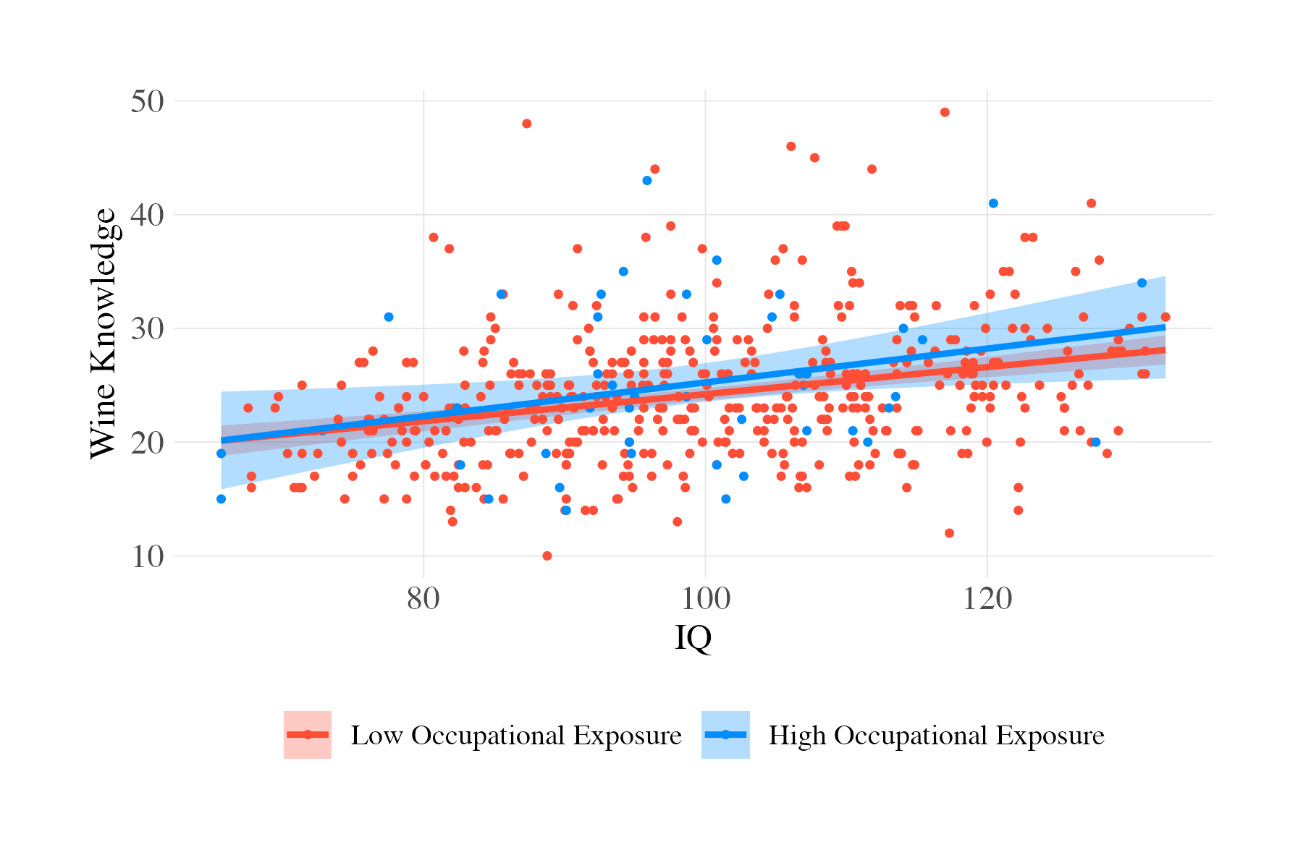
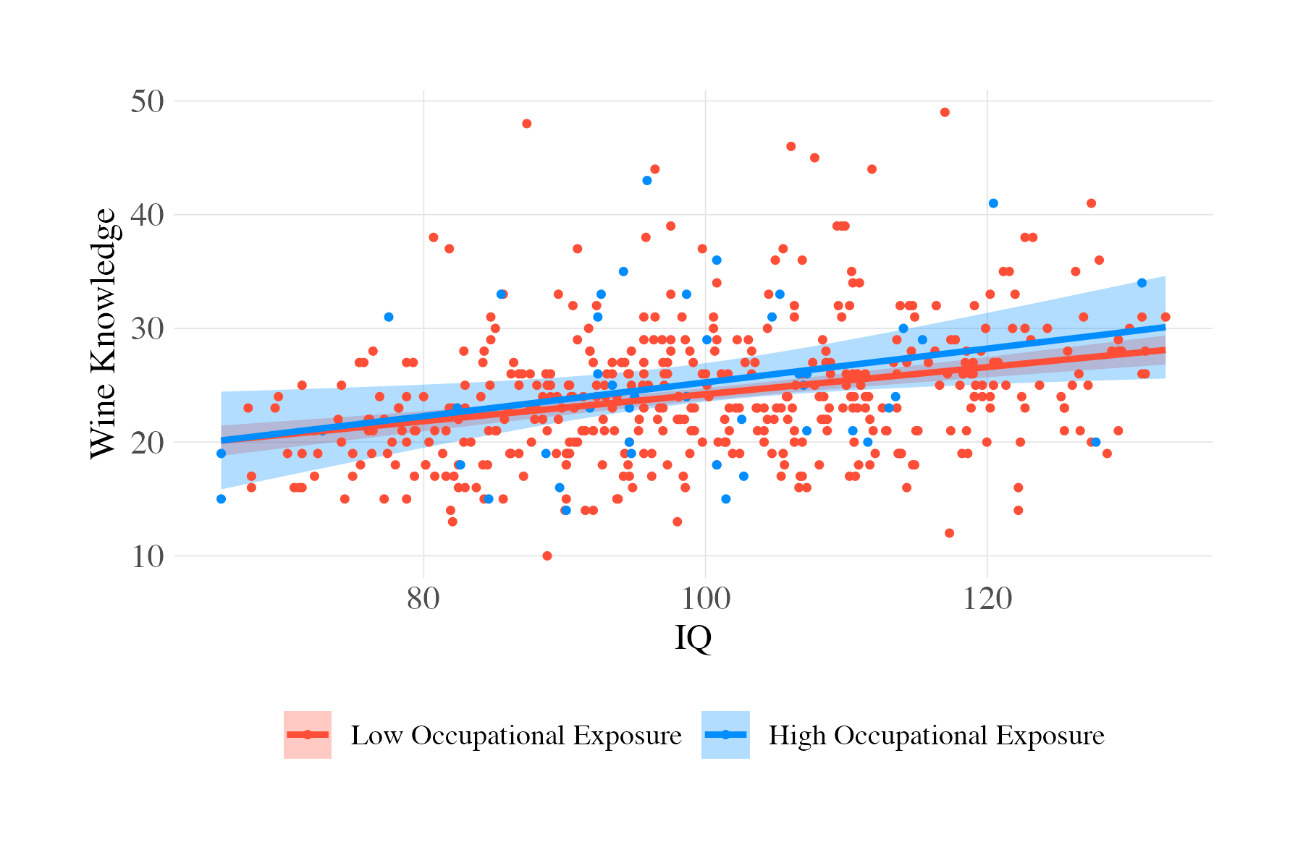
We next tested hypothesis 2 – that this association of wine knowledge and cognitive ability would survive controlling for domain-relevant environments in the form of occupational exposure. Using linear models with wine knowledge as the dependent variable, and IQ as a predictor, we first added experience in the wine industry as a potential main effect, and moderator of effects of cognitive ability. Occupational exposure was treated as an ordinal predictor across four levels, ranging from no experience to certified retail expertise (see Method for detailed coding). This model with wine experience added explained more variance (R² = .143, adjusted R² = .137) and significantly improved prediction over the IQ-only model (F(2, 496) = 14.03, p < .001). IQ remained a significant predictor (β = 0.31, 95% CI [0.23, 0.40], p < .001). However, wine experience was also independently associated with higher WSET 2 scores (β = 0.17, 95% CI [0.09, 0.25], p < .001) and the interaction of IQ with wine experience was a significant predictor of wine knowledge, i.e., the IQ–wine knowledge association was strongest in those with greater occupational exposure (β = 0.14, 95% CI [0.04, 0.24], p = .005). These results are shown graphically in Figure 1. Consistent with a cumulative model of knowledge acquisition, individuals with both high intelligence and relevant occupational experience demonstrated the highest wine knowledge scores, underscoring the additive and interactive contributions of IQ and specific knowledge.
We next tested if participants’ wine drinking behavior moderated the IQ–knowledge link. Wine use was coded as an ordered factor: teetotal, beer-preferring, and wine-preferring individuals. Wine drinking was significantly and positively associated with wine knowledge (β = 0.35, 95% CI [0.20, 0.49], p < .001). Unlike work experience, however, wine drinking per se did not interact with cognitive ability in predicting wine knowledge (p > .49). This suggests that general wine drinking differs from effects characterizing occupational training. This model accounted for 13.4% of the variance in WSET 2 scores (R² = .134, adjusted R² = .125).
Finally, a comprehensive model included both occupational exposure and wine drinking behavior as moderators of the IQ–knowledge relationship. IQ remained a strong predictor (β = 0.31, 95% CI [0.22, 0.39], p < .001), as did occupational exposure (β = 0.15, 95% CI [0.07, 0.23], p < .001) and wine drinking behavior (β = 0.33, 95% CI [0.19, 0.47], p < .001, linear trend). The interaction between IQ and wine experience remained significant (β = 0.16, 95% CI [0.06, 0.25], p = .001), whereas wine use did not interact with IQ. The combined model explained 17.8% of the variance in wine knowledge (R² = .178, adjusted R² = .169).
Discussion
We tested whether intelligence predicts knowledge in a specialized domain—wine knowledge. Two main findings emerged. First, intelligence was a significant predictor of wine knowledge, even after controlling for occupational exposure in the wine industry and wine consumption. Second, intelligence interacted positively with occupational exposure, such that individuals with higher IQ and greater occupational exposure demonstrated disproportionately high scores on wine knowledge. For wine consumption, independent main effects of ability and of consumption on knowledge were found, but no interaction in this case. These results provide empirical support for Jensen’s (1998) hypothesis that g operates as a primary engine for knowledge accumulation, regardless of content domain and formal reward structures. More broadly, the findings support the generalizability of the “g nexus” beyond traditional educational and occupational contexts. The observed association suggests that general intelligence contributes not only to formally reinforced learning outcomes, but also to the accumulation of specialized knowledge in self-directed and culturally embedded domains of expertise.
These findings are consistent with theories positing that intelligence serves as a domain-general mechanism for acquiring structured knowledge, even outside formal educational and occupational settings (Ackerman, 1996; Horn & Cattell, 1967). They extend prior work showing strong associations between intelligence and incentivized domains like financial literacy (Gignac & Stevens, 2024) and economic knowledge (Lin & Bates, 2022), by demonstrating that such associations also hold in a culturally specific, non-incentivized knowledge domain. By replicating these effects in the “neutral” field of wine expertise, we provide evidence that the IQ–knowledge link is not merely a byproduct of SES-linked motivation but reflects the cognitive demands involved in acquiring, organizing, and applying complex information. This interpretation also bears on debates about practical intelligence. Sternberg (1985) proposed a “triarchic” theory in which practical intelligence and contextual adaptation are distinct from conventional analytical ability. However, Gottfredson (2003) argued that much of what is described as practical intelligence may reflect the operation of g in everyday and contextually rich tasks. Wine knowledge may appear culturally niche or experiential on the surface, yet mastery of the domain requires learning elaborate classification systems, integrating semantic and sensory information, distinguishing subtle categories, and organizing knowledge across grapes, regions, production methods, and styles. At the same time, wine occupies a distinctive cultural position as a socially valued and often status-signaling form of expertise associated with refinement, taste, and cultivated knowledge. This makes wine particularly interesting as a test case because it combines relatively low formal educational exposure with substantial cultural visibility and symbolic value. Moreover, the interaction between intelligence and domain experience supports interactive models of expertise development, where cognitive ability and contextual exposure jointly shape the acquisition of crystallized knowledge (Ackerman, 1996; Schmidt, 2002).
An implication of the present findings is that general knowledge – often viewed as a broad but necessarily shallow pool of information and tightly driven by exigencies such as schoolwork – may be surprisingly deep and, paradoxically, specific. Our results suggest that the same cognitive mechanisms that allow individuals to pick up disparate facts about the world (Hambrick et al., 2007) also facilitate the construction of dense, specialized knowledge structures (Jensen, 1998). This “deep shaft” approach reveals that intelligence does not just predict who knows a little about many important things, but who masters intricate taxonomies and subtle dimensions of a single domain without formal education pressure. This aligns with findings that high-g individuals effectively “harvest” information from their environment even when that information lacks immediate instrumental value (Lubinski, 2004). This capacity for deep, self-directed knowledge acquisition suggests that g acts as a universal catalyst for expertise, regardless of the extrinsic rewards associated with the domain.
The present findings can also be interpreted in light of experience-producing drive theory of intelligence (Bouchard, 1997). According to this account, differences in knowledge reflect the active selection, shaping, and sustaining of experiences by high- versus low-ability individuals. This contrasts with learning efficiency models in that it gives primacy to the choice to enter, maintain, and elaborate cognitively rich environments. Applied to the present results, the prediction would be that brighter individuals have a drive to produce experiences – in this case experiences of wine. The theory should, then, predict that self-guided experience predicts knowledge, and that IQ fails to predict knowledge controlling for a proximal measure of experience – both of which we could test here contrasting enhanced learning efficiency and active selection of rich cultural niches. The results did not corroborate the experience producing drive model: ability predicted whereas self-directed wine exposure did not. Further research distinguishing these routes would be of considerable value, and the models differ in the prediction regarding whether, so to speak, it is enough “to take a horse to water”, or if a key to the accumulation and durability of knowledge in high-IQ individuals is due to “wanting to drink”, no pun intended.
An important focus for the paper was to choose a domain – wine knowledge as assessed here – which bears little resemblance to academic curricula or general job training. The content is taxonomy, process knowledge, viticulture, and geography which is rarely taught and may be actively avoided in educational settings and not formally required outside specialized hospitality or retail contexts (for which we controlled). Moreover, for non-industry participants, wine expertise does not typically yield career advancement or financial reward. Thus, the observed relationship of IQ to knowledge in this context contradicts views that intelligence is “merely a proxy” for exposure to education (Ritchie et al., 2015). This reinforces Jensen’s view that g is a causal driver of learning rather than a sociological artifact.
The absence of an interaction with behavioral exposure to wine consumption deserves further explanation. While professional experience amplified the effect of IQ, personal consumption – despite being a positive main effect – did not. This should be replicated, but if validated would suggest conditions within which ability × situation interactions should be expected. The data suggest that while g acts to linearly increase knowledge even in unstructured exposures, the structured/rewarded circumstances trigger interactive properties. The literature on deliberate practice (Macnamara et al., 2016) may be of relevance here, allowing higher intelligence to manifest as superior knowledge gains over time due, for instance, to the incorporation of retrieval practice (Roediger & Butler, 2011) acting as a multiplier of ability effects.
From a theoretical standpoint, these findings align well with Cattell’s (1987) investment model of fluid and crystallized intelligence. Wine knowledge, as structured factual knowledge gained over time, is archetypal crystallized intelligence (Gc). Our results suggest that fluid intelligence (Gf) – indistinguishable from g (Kan et al., 2011) – contributes to this accumulation, enhancing the learning, retention, and integration of domain-relevant information – especially when individuals are actively exposed to the domain through professional experience, as supported by the significant interaction between IQ and occupational exposure.
Limitations and Future Directions
While the present results are robust, several limitations must be acknowledged. First, our measure of wine knowledge was derived from the WSET Level 2 syllabus but did not use the official, certified exam. Although we replicated the format and content structure using publicly available materials (Wine and Spirit Education Trust, 2023), the absence of a proctored, certified WSET test may limit comparability with formally trained individuals. Second, we did not assess the tasting component of wine expertise. Sensory discrimination and memory may involve distinct cognitive processes from declarative knowledge, potentially involving perceptual learning and olfactory acuity (Hughson & Boakes, 2002). Third, while we controlled for occupational exposure in the wine industry and wine consumption, our cross-sectional design limits definitive causal claims. Future studies would also benefit from more fine-grained measures of occupational exposure. The present study distinguished broad levels of wine-related professional involvement, but additional variation in duration of experience, intensity of wine-related responsibilities, customer interaction, and expectations for domain expertise may help clarify the specific forms of structured exposure that most strongly amplify the association between intelligence and specialized knowledge acquisition. Future studies would likewise benefit from more fine-grained measures of wine-related behavioral exposure. For instance, the ability to chat with AI may be increasing potential for exposure to expert-level regional, varietal, production etc. knowledge. The present study used a broad categorical measure of wine preference, but richer indices of engagement – such as frequency of wine consumption, purchasing behavior, vineyard visits, hosting behavior, or preferences across wine categories – may better capture experiential exposure to wine and could potentially reveal stronger or more interactive associations with intelligence. Although intelligence often precedes knowledge acquisition, longitudinal designs would allow for stronger causal inference regarding the role of g in the accumulation of domain-specific expertise over the lifespan. Finally, future work could extend this approach to other forms of esoteric or “hobbyist” knowledge, such as classical music or birdwatching, to test the generality of our findings regarding self-directed, intrinsically motivated learning. It may also be informative to compare generalization of this effect across domains differing in prestige, social desirability, and practical utility to better understand how intelligence contributes to the accumulation of crystallized knowledge.
Conclusion
The present findings offer convincing evidence that general intelligence predicts the acquisition of specialized, incentive-neutral knowledge. By showing that IQ is associated with wine knowledge even after controlling for occupational exposure, and that it interacts positively with domain exposure, this study reinforces the conceptualization of intelligence as a domain-general learning capacity. Consistent with Jensen’s (1998) assumption, intelligence’s influence extends beyond the classroom and workplace into areas where knowledge is pursued for its own sake. These findings support theoretical models of intelligence as a driver of lifelong learning and structured knowledge accumulation, regardless of external rewards.